


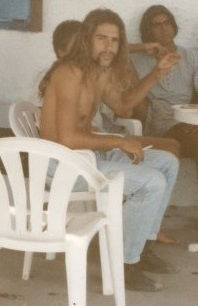


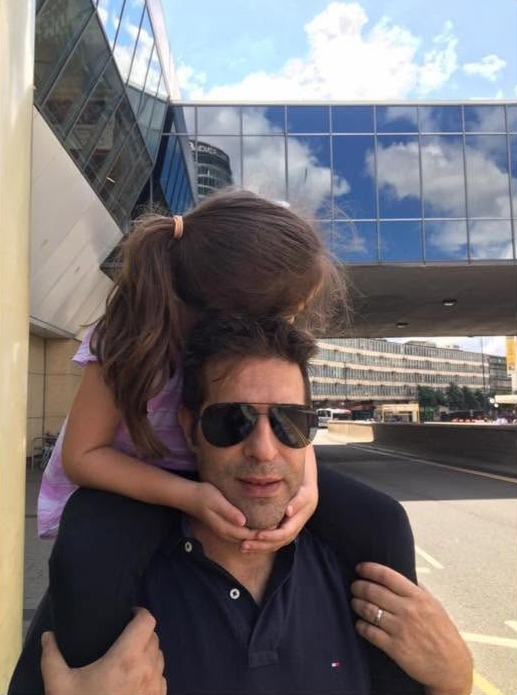


Born in 1973 in Athens, Greece. Yes, firmly Gen X, as my daughter recently reminded me.
I grew up in an Athenian suburb called Kallithea. For as long as I can remember, I was always on a bicycle, often giving my parents minor heart attacks due to various bike-related accidents.
This passion eventually led me into competitive cycling for nearly 12 years, with several wins in national championships and participation in international races.
Alongside cycling, I graduated from high school in 1991 and started my first job in a pizza shop, which was my first real exposure to the working world.
Both cycling and my early career were interrupted when I began my military service in 1994, which I completed in August 1995.
From September 1995 onward, I returned to work. This time as a delivery driver and routes controller. This marked my early introduction to logistics, at a very formative stage, but one that proved valuable for my future path.
In September 1996, I enrolled in a Greek college for a two-year program in Marketing and Advertising. This was my introduction to the fascinating world of business.
At 22, I began to understand consumer behaviour, why we buy, what motivates us, what happens behind the scenes to launch a product or service, how market research is structured and conducted, how businesses operate, how to plan within constraints, and how channels are optimized. The marketing mix and its application opened up a truly mesmerizing world.
By 1998, when I graduated, I believed everything revolved around marketing, but I was ready for a more financially driven “adventure.”
So, I enrolled in another two-year program in Finance, focusing on stock exchange analysis and trading.
This was a tougher, more unforgiving world, where real money, assets, and investments demanded returns. Fundamental analysis, accounting literacy, and performance evaluation became essential.
This is where I first encountered the concept of KPIs.
KPIs to assess inventory cycles, revenue generation, and operational efficiency. Others to evaluate cash flow, the acid test ratio, current ratio, quick ratio, debt-to-equity ratio, gross and net profit margins, P/E, EBITDA, ROE, and more.
I also explored supply and demand dynamics, elasticity, investment depreciation, and macroeconomic influences on microeconomic environments.
And, of course, trading itself, why to trade, how to trade, candles, long and short positions, profits, commissions, taxes, and duties.
By January 1999, I was already working for a stock exchange trading company in Athens.
At 26, I was fully immersed in the stock exchange world analysing, forecasting, applying both fundamental and technical analysis, executing trades, and managing settlements at the end of each trading day.
Unfortunately, by late 1999, the overvaluation of the Greek stock exchange surfaced, dragging down companies, indices, and ultimately the entire industry.
I graduated in July 2000, but the company I was working for could not withstand the crisis and eventually went into administration.
In September 2000, I transitioned into operations for the very first time.
Moving from a high-pressure trading environment to a corporate office within one of Greece’s largest publishing groups as a Junior Imports Officer, was both smooth and challenging.
Here, I dealt with tangible commodities (publication paper), strict deadlines, and operational KPIs such as OTIF, Perfect Orders, supplier performance, and SLAs.
A new world was unfolding, one with broader scope and fewer boundaries.
Operations spanned supply chain (procurement, purchasing, warehousing, logistics, inventory management), as well as health and safety, facilities management, marketing, HR, legal, finance, and sales.
Within eight years, I earned two promotions in a highly competitive environment, reaching the position of Senior Procurement Manager.
From the paper industry, I moved into hospitality, joining a well-known Greek resort in Northern Greece as Senior Procurement Manager as well.
This was a complex operation: three hotels (~1,800 keys), over five restaurants, two spas, gyms, event halls, a horse-riding club, a winery, retail shops, maintenance facilities, and a marina for private yachts.
My journey then took me between Athens, Greece and Nicosia Cyprus, with a manufacturing and wholesale company trading Greek FMCG products: olive oil, jams, and sauces.
Here, I had the opportunity to combine marketing insight, financial discipline, procurement expertise, and operational strategy.
This led to the company’s flagship product being awarded in an international competition. A rewarding outcome of a significant effort.
By 2011, the Greek economic crisis had taken hold, and its aftermath affected every aspect of business and trade.
Soon after, I relocated to Dubai as a Purchasing Manager, and within less than a quarter, I was promoted to Operations General Manager.
I led a division covering planning, procurement, warehousing, logistics, and inventory control, with over 120 personnel and five direct reports.
I built operations literally from scratch, since my predecessor left nothing behind, reducing slow-moving inventory, optimizing SKU structures, renegotiating and terminating inactive contracts, developing local supplier networks, and implementing KPIs across all operational functions, to name a few.
We improved performance, engagement, and alignment with measurable goals achieving significant savings and operational upturns.
Each day brought new challenges, requiring both strategic thinking and hands-on execution to maximize customer experience and satisfaction.
Due to a family matter, I returned to Europe.
After a while I took on a role as Group Purchasing Manager for non-product-related materials and services within a multinational group based in Sweden, with operations across the UK and the Netherlands (two manufacturing units), Europe, China, and North America (all business units).
It was an extremely demanding role, with extensive travel, no direct reports, and involvement in ongoing acquisitions.
It led to burnout.
After a short break, I transitioned into a new industry: architecture and construction in the UK.
I spent around 4 months understanding how architects work and why. I studied construction processes, contracting frameworks, regulatory bodies, and market dynamics.
I adapted quickly and introduced a more commercial approach to project development and delivery.
By developing a CRM system aligned with contract schedules and cost structures including overheads, we improved planning accuracy and shifted organizational culture.
On the construction side, implementing structured RFP processes, enforcing schedules through Gantt charts, and revising contracts created smoother operations and stronger financial control for both internal teams and external stakeholders.
After six rewarding years, (and becoming an expert in designing in Revit and visualising with Enscape) I felt ready for the next step…
