
Mastering the Metrics: Understanding and Designing Effective KPIs

Updated: Jul 8

Inspired by a morning chit-chat, let’s talk about Key Performance Indicators (KPIs): what they are, what they aren't, how to set them up, and how to use them effectively.
First and foremost, KPIs are measuring tools. They help you objectively evaluate performance using specific units of measurement over a defined period.
Important Distinction: A target is not a KPI. Rather, a target is either a goal that a KPI helps you achieve, or a metric that impacts a higher-level KPI while carrying a predetermined weight within it.
KPIs are highly customizable tools that can be tailored precisely to an organization’s unique needs. Beyond the standard industry metrics, such as Customer Conversion Rate for Sales, Customer Acquisition Cost for Marketing, Employee Turnover Rate for HR, or Total Acquisition Cost for Supply Chain, you can develop bespoke KPIs to monitor specific operational nuances.
A Practical Example: The Schedule Adherence KPI
Imagine you notice a trend of late arrivals and early departures. The standard working hours are 09:00 to 18:00 (including a one-hour lunch break), with a 10-minute arrival and departure tolerance window.
By extracting data from your security entry/exit system, you can develop a custom KPI to track attendance based on the following parameters:
There is no overtime policy.
The lunch break is exactly one hour.
The target window is an arrival at 08:50 and a departure at 18:10.
The Formula
The total expected time on-site within this window (minus the lunch break) is 500 minutes. The formula to measure adherence is:

Denominator (500): The total minutes between 08:50 and 18:10, minus the 60-minute lunch break.
Actual Eligible Minutes: The actual time the employee spent on-site.
Note: This specific KPI does not offer credit for early arrivals or late departures, though a different company policy could easily accommodate that and incorporated in this KPI. Alternatively, this KPI could be simplified into a binary Pass/Fail format.
Data Visualization & Insights
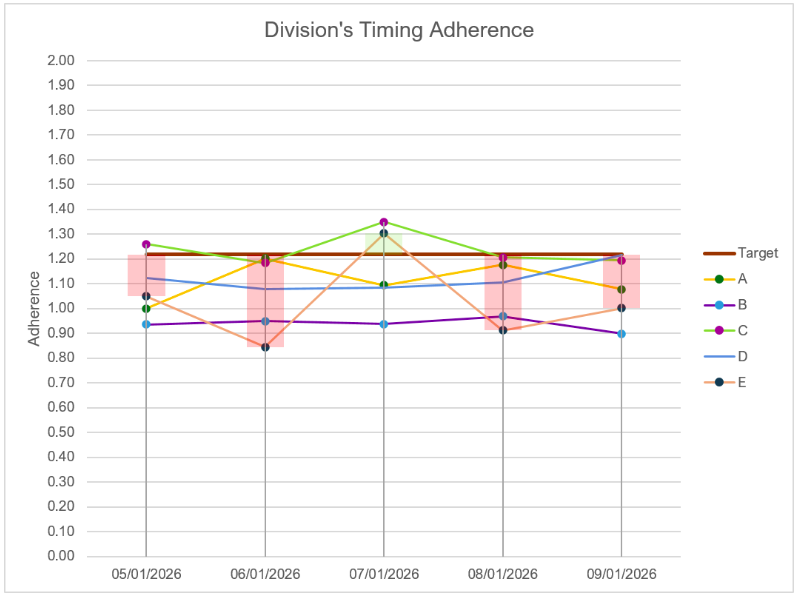
With this visual KPI, management gains immediate clarity on:
Each employee's adherence to the schedule.
The specific days the team, on average, met or missed the target.
Which employees require closer management or support regarding timekeeping.
Ultimately, this data influences employee performance reviews, future target restructuring, and broader management decisions.
Scaling the Impact
This is a fundamental (if not primitive and simple) example of a tailored KPI. In practice, a metric like this can be enriched with additional layers, such as productivity per hour, the critical nature of the role, or a time-management index.
While the target is represented as a solid red line on a graph, it remains a distinct element to strive for or reconsider. Whether or not it is achieved will, in turn, influence higher-level organizational KPIs, such as a company-wide Pass/Fail index, bonus distributions, or promotional grading.
Isn’t it remarkable how distinct a target and a KPI actually are? And isn’t it fascinating how an organization of thousands can be effectively run by KPIs that examine the smallest units of operation?
A final piece of advice: If you want to successfully run a department, a division, or an entire organization, never underestimate the power of KPIs. As long as you ensure your data source is solid, they will always show you the true picture.


Comments